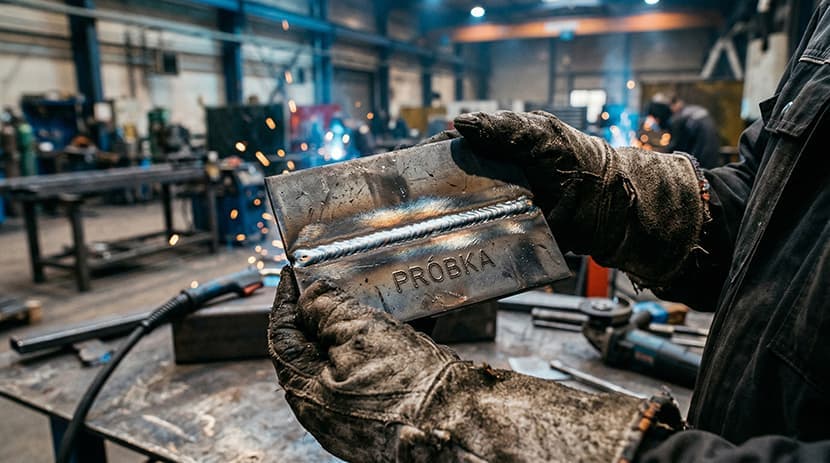
How to Pass "Próbki" in Poland: What Welders Need to Know About Factory Tests
The practical test (passing the "pipe test") is the main fear before getting a job in Poland. We analyze in detail: how the exam is conducted, what the examiners are picky about, and how to guarantee a high score the first time.
For many welders planning to work in Poland, the most terrifying stage is not getting a visa or moving, but the practical exam at the production facility—the so-called "próbki" (from Polish próbki – samples/test pieces). Even specialists with 20 years of experience often get nervous and make rookie mistakes due to stress or lack of knowledge of European standards.
In this article, we will explain in detail how the testing works, what Polish inspectors look for, and how to prepare so you can get your desired hourly rate on the first try.
What are "próbki" and how does the test work?
Passing the próbki is your ticket into the factory. It’s not enough for employers to just see a diploma or certificate; they need to see your real skills "here and now".
Usually, the test goes like this:
Briefing: You are given a technical drawing or a Welding Procedure Specification (WPS). It specifies the method (e.g., 135 or 141), metal type, material thickness, and welding position.
Preparation: You receive two metal plates or pipes (these are the "próbki"). You have time to adjust the welding machine to your liking, selecting the right current and voltage on scrap pieces of metal.
Welding: You perform the weld in the specified spatial position (most often this is PF – vertical up, or HL045 for pipes).
Inspection: The finished sample is taken by an inspector (Quality Controller) for testing.
How is your weld inspected?
Polish factories operate under strict European standards (EN ISO), so the inspection is often multi-level:
Visual Testing (VT): The very first stage. The inspector evaluates the geometry of the weld. The weld must be even, without scaling, undercuts, overlaps, and external pores. Always clean the spatter (slag) around the weld!
Mechanical Testing (Fracture test): Your sample may be placed under a press and broken right along the weld or the heat-affected zone. If large pores, slag inclusions, or lack of root penetration are found inside the weld—you fail the test.
Macroscopic Examination or X-Ray (RT/UT): At serious production facilities (e.g., shipbuilding or tank manufacturing), welds are "x-rayed" or ultrasonically tested to detect microcracks.
TOP 3 mistakes welders make during tests:
Rushing and ignoring preparation: Many immediately start welding the final test piece without adjusting the machine on scrap plates. The result—burn-through or lack of penetration at the start.
Poor cleaning: European standards require absolute cleanliness. If you don't clean the metal from rust or paint before welding, or fail to remove slag between passes—you are guaranteed to get pores in the weld.
Not knowing welding positions: Poland uses the European marking for positions (PA, PB, PC, PF, PE). If you don't know what "weld plates in the PF position" means, you won't even be able to properly position the part on the table.
Advice from Zvaryuvalnyk.xyz recruiters:
Never hesitate to ask! If you don't understand the drawing or the welding mask doesn't fit—tell the foreman before you start welding. Poles value communication and a responsible approach to safety much more than silent mistakes.
Looking for verified jobs with transparent testing conditions? Go to the "Vacancies" section—we only work with reliable employers who give you time to adapt!
Looking for a job?
Leave your contacts and we will find the best vacancy for you.